- English
- French
- German
- Portuguese
- Spanish
- Russian
- Japanese
- Korean
- Arabic
- Greek
- German
- Turkish
- Italian
- Danish
- Romanian
- Indonesian
- Czech
- Afrikaans
- Swedish
- Polish
- Basque
- Catalan
- Esperanto
- Hindi
- Lao
- Albanian
- Amharic
- Armenian
- Azerbaijani
- Belarusian
- Bengali
- Bosnian
- Bulgarian
- Cebuano
- Chichewa
- Corsican
- Croatian
- Dutch
- Estonian
- Filipino
- Finnish
- Frisian
- Galician
- Georgian
- Gujarati
- Haitian
- Hausa
- Hawaiian
- Hebrew
- Hmong
- Hungarian
- Icelandic
- Igbo
- Javanese
- Kannada
- Kazakh
- Khmer
- Kurdish
- Kyrgyz
- Latin
- Latvian
- Lithuanian
- Luxembou..
- Macedonian
- Malagasy
- Malay
- Malayalam
- Maltese
- Maori
- Marathi
- Mongolian
- Burmese
- Nepali
- Norwegian
- Pashto
- Persian
- Punjabi
- Serbian
- Sesotho
- Sinhala
- Slovak
- Slovenian
- Somali
- Samoan
- Scots Gaelic
- Shona
- Sindhi
- Sundanese
- Swahili
- Tajik
- Tamil
- Telugu
- Thai
- Ukrainian
- Urdu
- Uzbek
- Vietnamese
- Welsh
- Xhosa
- Yiddish
- Yoruba
- Zulu
Why OEM Pork and Scallion Dumplings Boost Restaurant Profits
If you run a Chinese supermarket, manage an Asian food distribution chain, or oversee frozen food procurement across North American retail channels, you already know that pork and scallion dumplings are not just a product — they are a perpetual velocity item. This classic filling combination drives consistent basket movement because it speaks directly to the taste memory of mainland Chinese consumers abroad. The real question is not whether to carry it, but how to source it in a way that protects your margin, guarantees uninterrupted supply, and eliminates compliance risk at customs. That is precisely where OEM manufacturing becomes a strategic lever rather than just a vendor arrangement.
Understanding the Market Needs for Pork and Scallion Dumplings
Why This Filling Dominates Frozen Dumpling Sales
The most popular jiaozi flavor in the Chinese diaspora market is the pork and scallion dumplings combination. This is because it strikes the perfect balance between the savory richness of ground pork front leg meat and the sharp aromatics of Welsh onion, creating a filling profile that is both familiar and satisfying. For procurement buyers, this means stable sell-through rates and low markdown risk, which are two things that directly protect gross margin.
Shifting Buyer Priorities in B2B Procurement
When buying frozen dumplings for the U.S. market, three things are becoming more and more important: label compliance (FDA registration, allergen statement for wheat and soy), cold chain stability during the 2–3 month sea freight journey, and packaging options for private-label programs. Because of these standards, smaller, less-equipped makers have been pushed to the sidelines, while real procurement talks have focused on certified, export-capable factories.
How OEM Pork and Scallion Dumplings Solve Restaurant and Retail Challenges
When you buy frozen foods from generic distributors, you usually run into the same issues: filling ratios that aren't uniform, wrappers that break when they're boiled, products that don't have enough shelf life when they arrive, and not being able to design the packing for your own brand. Each of these issues has a real cost: unhappy customers, stock that can't be sold, and missed restock rounds.
These problems are fixed at the production level by OEM making. When a maker makes your product according to certain rules, like the thickness of the wrapper, the amount of filling to the wrapper, and the piece weight tolerance, those rules are locked into the production run and checked by in-line check-weighers and sensory panels before the box closes.

This makes a product that works the same way no matter what cooking method is used: boiling for 6 to 8 minutes, steaming for 10 to 12 minutes, or pan-frying to a crispy crisp base using pork and scallion dumplings (with these dumplings serving as the standard reference for all process parameters, from filling ratio to wrapper thickness).
Core Advantages of OEM Pork and Scallion Dumplings for Restaurants
Here are the main reasons why OEM sourcing is the best option for people who buy a lot of frozen dumplings:
- Standardized ingredient traceability: Premium OEM suppliers get their pork from verified chilled-meat suppliers and use Canadian or Hetao Plain wheat flour. These are raw materials with clear provenance that are checked for pesticide residue and microbiological issues before they go into production using pork and scallion dumplings.
- Cold chain continuity: A company with an 8,000-ton intelligent shuttle rack cold storage system that stays at -18°C all the time and GPS-monitored refrigerated transport makes sure that the integrity of the product is maintained from the packing line to the receiving dock. This eliminates the risk of thaw-refreeze, which leads to customer complaints and whole-container claims.
- Packaging scalability for private label: OEM partners offer 450g retail bags, 1 kg mid-tier packs, and 2.5 kg restaurant cases that can all be customized with your brand's artwork. Because of this, you can use a single business relationship to sell your goods in a number of different retail outlets, such as a local Chinese grocery store, a warehouse club, and a foodservice distributor.
- Compliance documentation support: OEM manufacturers that are qualified have ISO 9001, HACCP, and SC (QS) certifications. They can make the allergen declarations, product specification sheets, and audit documentation that U.S. customs brokers and retail buyers need before a new SKU leaves the port.
Comparing OEM Dumplings with Other Market Solutions
When purchasing managers look at their sourcing options, they usually look at four things: unit cost, batch consistency, minimum order flexibility, and the ability to customize labels. The table below shows how OEM-made pork and scallion dumplings stack up against homemade versions, generic store-bought imports, and bulk frozen choices that don't have a brand name on them.
You can control the taste of homemade or commissary goods, but they don't scale well—the cost of labor per kilogram goes up sharply above modest amounts, and it's hard to make food safety paperwork for retail compliance checks. Generic import frozen dumplings are cheaper, but most of the time they don't have the private labeling and certification levels that big U.S. stores need, nor do they offer specific fillings like pork and green onion that can differentiate a product on crowded shelves. Bulk frozen food that isn't branded has the lowest entry cost, but the quality varies the most and there isn't much accountability in the cold chain.
Under all four conditions, OEM buying is the best option when the amount of goods being bought is full containers. The cost per unit goes down as you buy more, the product specifications are set by contract, and the maker handles approval, which would normally be the job of your compliance team. For buyers who spend between $500K and $1.5M a year on frozen dumplings, having a stable relationship with the OEM makes each repeat cycle much more productive.
Operational Insights: Handling, Cooking, and Serving
To keep the quality of the product after it arrives, you must store it at -18°C throughout your own cold chain. Any change in temperature above -12°C can cause ice crystals to re-crystallize, which damages the smoothness of the wrapper and makes it more likely to break when it boils. During the receiving inspection, the core temperature should be checked, and condensation inside the cartons should be looked for as a sign of a previous thaw event for pork and scallion dumplings.
From the point of view of food service preparation, all three cooking ways work well with this product. After the dumplings float, boiling them in salty water for 6–8 minutes makes a soft, whole wrapper. By adding a little water to the pan and covering it, you can pan-fry something that has a crisp bottom and a steamed top. This is a good way to take pictures and support premium menu positioning. Adding soy sauce, Chinkiang vinegar, or chili oil to a dish completes the appearance without making it harder to work in the kitchen.
Brand Spotlight: Shandong Zhu Laoda Food Co., Ltd.
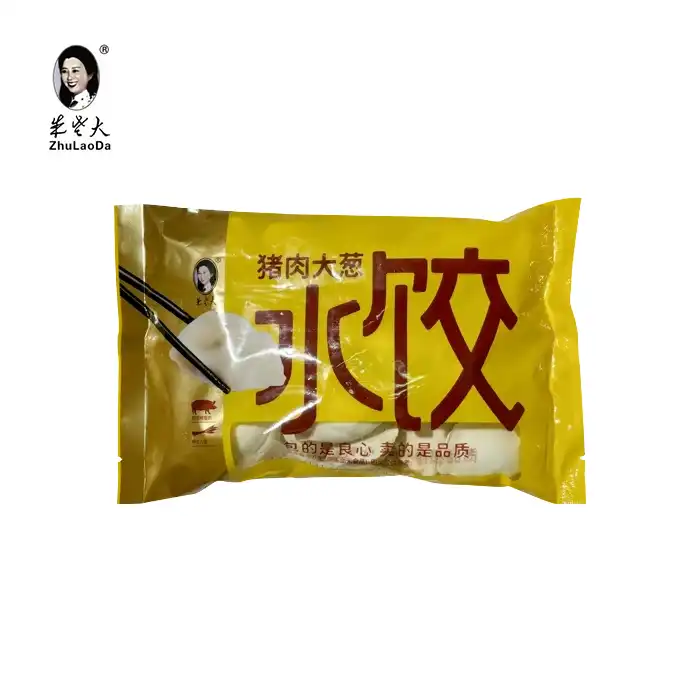
Since it began in March 2001, Shandong Zhu Laoda Food Co., Ltd. has become one of the best-equipped companies in southern Shandong and northern Jiangsu to make frozen foods, with its core product lineup including pork and green onion dumplings as a flagship offering. The 8,000-ton clever cold storage system mentioned above helps the company run its three automatic production lines, which can produce up to 100 metric tons of pork and scallion dumplings every day.
Getting raw materials shows the same level of discipline. The pork only comes from Jinluo, which is one of China's best-known chilled-meat brands. Wheat flour comes from Canada or the Hetao Plain, and fresh vegetables are bought straight from farms where they grow. Before it gets to the processing floor, all incoming materials are looked at for appearance, tested for pesticide residue, screened for microbes, and given a physicochemical analysis.

The business has a food production license number of SC11137139600148 and a product standard code of SB/T 10412. The dumpling filling is made with wheat flour, pork front leg meat, Welsh onion, cabbage, vegetable oil, onion, ginger, soy sauce, edible salt, monosodium glutamate, and acid-hydrolyzed vegetable protein flavor powder. All of the ingredients are clear. Note for people with allergies: the product has parts made of wheat and soy. At -18°C, it will last for 12 months.
Conclusion
OEM sourcing isn't just a way to cut costs; it's also a choice about how to structure the supply chain. If a buyer is in charge of restocking full containers of pork and scallion dumplings on a regular basis in U.S. retail or wholesale channels, the right OEM partner can get rid of the three risks that consistently hurt profits: inconsistent product quality, failures in the cold chain, and not following the rules at the border. Your frozen food business needs a manufacturer with confirmed certifications, raw materials that can be tracked, and the production scale to handle your number without affecting wait time.
FAQ
What is the minimum order quantity for OEM frozen dumplings?
Most qualified OEM manufacturers can handle trial orders starting at around 500 kg. This lets buyers check the quality of the pork and scallion dumplings, the integrity of the wrapper, and the filling ratio before committing to full-container volumes. First-order risk is cut down a lot by this framework.
What certifications should I require from a frozen dumpling OEM supplier?
At the very least, you should ask for proof of ISO 9001, HACCP, and SC (food preparation license). To get into the U.S. market, make sure the maker can help with FDA facility registration and provide allergen statement papers that meet FDA labeling standards. For store compliance, these papers can't be changed.
Can packaging be customized for private-label programs?
Yes, reputable OEM providers can customize packing for a range of SKU sizes, usually 450g, 1kg, and 2.5kg, and they can also help with co-developing artwork. Before you place your order, make sure you know the requirements for a print-ready file and the wait time for packaging materials.
How do I verify cold chain integrity during sea freight?
Ask the manufacturer's transportation partner for GPS-monitored temperature logging paperwork, and when the container arrives, check the state of the cartons and the temperature of the core products inside. A shelf life of 12 months at -18°C is long enough to cover a 2–3 month sea freight transit.
Partner with Zhulaoda — Your Trusted Pork and Scallion Dumplings Supplier
Zhulaoda has what serious procurement buyers need: approved production, 8,000-ton cold storage, a shelf life of 12 months, and the ability to offer OEM and private label options in 450g, 1kg, and 2.5kg forms. As a well-known company that has been making pork and scallion dumplings for over twenty years and has exported their goods, we can help you with your compliance paperwork, trial samples, and full-container restocking rounds. To get samples and prices, email us at sdzldsp@163.com or go to zhulaodadumpling.com.
References
1. Mintel Group. Frozen Foods: Market Trends and Consumer Insights. Mintel, 2023.
2. Grand View Research. Asia Pacific Frozen Food Market Size & Forecast Report. Grand View Research, 2023.
3. Food and Drug Administration (FDA). Food Labeling Guide: Allergen Labeling Requirements. U.S. Department of Health and Human Services, 2022.
4. International Food Information Council (IFIC). Consumer Perspectives on Food Safety and Labeling. IFIC Foundation, 2023.
5. China National Standard Committee. SB/T 10412: Frozen Dumplings Product Standard. Ministry of Commerce of China, 2007.
6. Euromonitor International. Packaged Food in China: Industry Overview and Export Dynamics. Euromonitor International, 2022.

Learn about our latest products and discounts through SMS or email