- English
- French
- German
- Portuguese
- Spanish
- Russian
- Japanese
- Korean
- Arabic
- Greek
- German
- Turkish
- Italian
- Danish
- Romanian
- Indonesian
- Czech
- Afrikaans
- Swedish
- Polish
- Basque
- Catalan
- Esperanto
- Hindi
- Lao
- Albanian
- Amharic
- Armenian
- Azerbaijani
- Belarusian
- Bengali
- Bosnian
- Bulgarian
- Cebuano
- Chichewa
- Corsican
- Croatian
- Dutch
- Estonian
- Filipino
- Finnish
- Frisian
- Galician
- Georgian
- Gujarati
- Haitian
- Hausa
- Hawaiian
- Hebrew
- Hmong
- Hungarian
- Icelandic
- Igbo
- Javanese
- Kannada
- Kazakh
- Khmer
- Kurdish
- Kyrgyz
- Latin
- Latvian
- Lithuanian
- Luxembou..
- Macedonian
- Malagasy
- Malay
- Malayalam
- Maltese
- Maori
- Marathi
- Mongolian
- Burmese
- Nepali
- Norwegian
- Pashto
- Persian
- Punjabi
- Serbian
- Sesotho
- Sinhala
- Slovak
- Slovenian
- Somali
- Samoan
- Scots Gaelic
- Shona
- Sindhi
- Sundanese
- Swahili
- Tajik
- Tamil
- Telugu
- Thai
- Ukrainian
- Urdu
- Uzbek
- Vietnamese
- Welsh
- Xhosa
- Yiddish
- Yoruba
- Zulu
Chinese Cabbage Tofu Dumplings vs Meat Dumplings: A Buyer’s Guide
If you're sourcing frozen dumplings at scale, understanding the practical differences between Chinese cabbage tofu dumplings and traditional meat-filled varieties can sharpen your procurement decisions significantly. Tofu and cabbage fillings deliver a clean, plant-based profile with lower saturated fat and no animal-derived ingredients, making them a reliable staple for vegetarian foodservice operators. Meat dumplings, by contrast, lean on fat-driven umami and denser texture to drive flavor. Both categories serve distinct market segments, and choosing incorrectly can affect menu positioning, customer retention, and margin stability.
Understanding the Core Differences Between Chinese Cabbage Tofu Dumplings and Meat Dumplings
Ingredient Composition and Nutritional Profile
Tofu-cabbage dumplings are filled in a way that is very different from pork or beef dumplings. Each serving of a tofu-cabbage mix usually has 8–12g of plant-based protein, 0g of cholesterol, and 0g of saturated fat. Twenty to thirty percent of meat dumplings' thickness comes from the animal fat they contain. The tofu-cabbage profile is better for buyers who want to meet the dietary needs of health-conscious customers, Buddhist eating groups, or veggie food service chains.
Sensory Attributes and Market Positioning
"Crunch-soft matrix" is what food scientists call tofu-based fillings. The insoluble fiber in cabbage adds texture contrast, and the denatured soy protein in pressed tofu helps with binding and elasticity. People who like traditional food like meat dumplings because they have a denser, more savory texture in the mouth. It's important to note that global dietary changes are happening. The Good Food Institute's 2023 industry report says that plant-based food retail sales in the U.S. topped $8 billion. This means that there is a steady increase in demand for vegetarian dumplings in both retail and foodservice channels.
Production and Procurement Considerations for Bulk Buyers
To get frozen dumplings in large quantities for business use, you need to carefully check the quality of the ingredients and the factory's ability to make them. Chinese cabbage tofu dumplings are a good example. Not every provider can meet clean-label standards and keep up a steady flow of work.
Before committing to a supplier, you should check these important production standards:
- Moisture management in tofu-cabbage filling: Industrial-grade production uses a two-step dehydration process—osmotic extraction via salting removes approximately 30% of cellular water from cabbage, while hydraulic-pressed tofu absorbs residual moisture during cooking. This prevents the "soggy wrapper" problem common in lower-grade vegetable dumplings.
- Freeze-thaw structural integrity: Quality suppliers formulate wrappers with high-gluten wheat flour and modified starch blends to resist cracking at –18°C. The filling-to-dough ratio, optimized between 55:45 and 60:40, ensures structural integrity through boiling, steaming, or pan-frying without seal failure.
- Aromatic preservation: Ginger and scallions within the filling are oil-infused or micro-encapsulated to prevent flavor dissipation over a 12-month frozen shelf life.

Because these standards have a direct effect on the quality of the product when it is eaten, seller plant checks are just as important as sample tastings.
Shandong Zhu Laoda Food Co., Ltd. has been in business since 2001 and has three automatic production lines that can make up to 100 tons of food every day. The company also has more than 8,000 tons of cold store space. Their production workshops have high-tech systems for sterilization and fresh air. Before going into production, all of their raw materials, like Canadian wheat flour and certified vegetables, are inspected by professionals who check for pesticide residue, microbes, and physicochemical indicators.
Cost, Pricing, and Market Positioning Analysis
Raw Material Cost Structure
Tofu-cabbage fillings use cheaper raw materials than premium meat versions. This is because Chinese cabbage and soybeans are common farming inputs that have stable supply lines. But following the rules for "净缒" (pure vegetarian) approval, having separate production lines, and making sure that allergens are kept separate can add costs that small workshops usually get rid of by cutting corners instead of controlling the whole process properly.
Pricing Strategy for B2B Buyers
Plant-based dumplings are a value-with-integrity product for food service companies and veggie food distributors. Chinese cabbage tofu dumplings are not more expensive, but they are more trustworthy. Buyers who stock vegetarian specialty sections in stores or Buddhist canteens often need proof that the ingredients are pure, which is what makes factory-produced SKUs different from alternatives made in local workshops. With 450g, 1kg, and 2.5kg bulk packaging options, procurement teams can match order volumes to weekly throughput, which lowers the cost of spoilage and keeping inventory.
Knowing how these costs change over time gives procurement managers the confidence to deal with sellers and create a product mix that meets both short-term demand and profit goals.
Quality, Safety, and Regulatory Compliance in Dumpling Procurement
Regulatory compliance is not just a formality; it is what makes the supply chain work every time. When buying frozen dumplings to sell, buyers need to make sure they meet a number of non-negotiable compliance marks.
The following things can be said about Zhulaoda's Chinese cabbage tofu dumplings:
- Product Standard Code: SB/T 10412
- Food Production License: SC11137139600148
- Storage Requirement: Below –18°C
- Shelf Life: 12 months
- Allergen Declaration: Contains wheat and soybean components
In addition to making sure their products are compliant, institutional buyers who want to sell to foreign markets or the vegetarian areas of supermarkets need suppliers who have the infrastructure for HACCP and ISO certification. These systems control how to keep things clean, keep track of the cold chain, and handle the risk of allergy cross-contact.

More and more, eco-friendly packaging innovations, like sleeve formats with less plastic and that can be recycled, are being taken into account in corporate procurement scorecards. This is especially true for foodservice groups in the U.S. market that have ESG commitments, where products such as cabbage and tofu must meet the same strict standards.
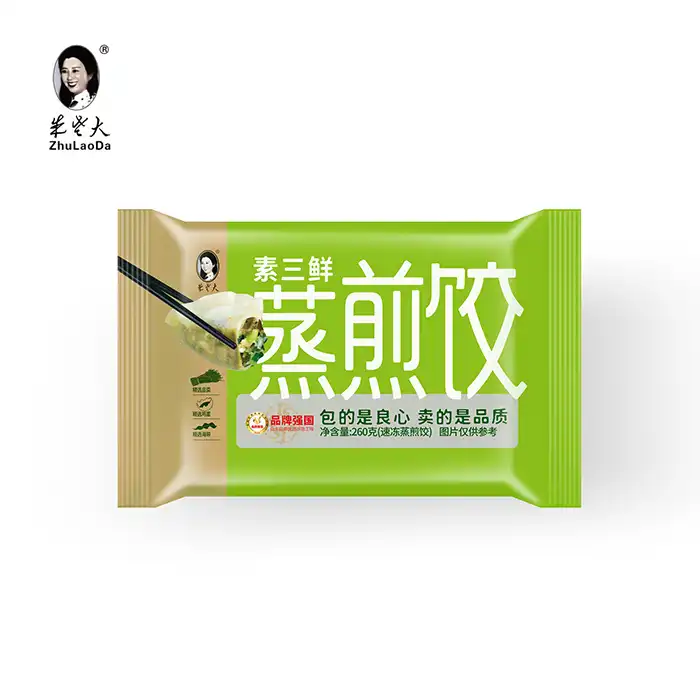
Zhulaoda's vegetarian dumplings are made with Wheat Flour, Tofu, Chinese Cabbage, Drinking Water, Noodles Made from Sweet Potato Starch, Scallions, Ginger, Vegetable Oil, Edible Salt, Monosodium Glutamate, Acid-hydrolyzed Vegetable Protein Seasoning Powder (Water, Edible Soybean Meal), and Distarch Phosphate. The full list of ingredients is available and can be tracked, which supports clean-label marketing at the retail level.
Making the Right Choice: Matching Your Business Needs to Dumpling Options
The right product for you depends on how you plan to use it. Tofu-cabbage dumplings are great for vegetarian restaurant chains, temple canteens, plant-based meal kit brands, and food distributors who work with health-conscious stores. In both mainstream foodservice and conventional frozen food aisles, meat dumplings are still the most popular item. There is no one style that always works better than the other. It all depends on your customers.
With private labeling and custom package choices, distributors can build a brand without having to spend money on production equipment. Long-term relationships between vendors and companies with verified production capacity lower the risk of supply disruptions, especially during busy shopping times of the year. For business owners who can't hold on to too much stock, flexible MOQ structures and quick restocking cycles (every week or every two weeks) are important.
Conclusion
It comes down to knowing your customers when deciding between Chinese cabbage tofu dumplings and meat-filled rolls. Tofu-based vegetarian dumplings offer clear labels, steady plant-based nutrition, and legal sourcing for businesses that cater to health-conscious or vegetarian customers. Different things make people want meat cakes.
The most important thing for procurement workers in both forms is to make sure that ingredients are clear, that producers have the right regulatory credentials, and that they can keep quality high at scale. Zhulaoda is a reliable place to buy large quantities of tofu-cabbage dumplings because they have a production system and written compliance standards.
FAQ
What makes tofu-cabbage dumplings suitable for pure vegetarian menus?
In normal versions, the filling doesn't have any animal-derived proteins, animal fats, or five-spicy vegetables. Before putting the word "net-vegetarian" on packaging or menus, buyers should always check directly with the supplier to make sure they know the exact recipe and the status of the dedicated production line.
How do I verify that a supplier's vegetarian dumplings are produced on a clean line?
Ask for the Food Production License (China SC license), HACCP paperwork, and a strategy for controlling allergens. Zhulaoda has the license number SC11137139600148 and follows strict rules for inspecting raw materials, which include looking for chemical residue and microbial signs.
What packaging sizes are available for bulk orders?
Standard sizes for commercial packaging are 450g, 1kg, and 2.5kg. Custom packaging layouts are available for buyers with their own brands and OEMs.
How should frozen dumplings be stored and transported?
Keep the cold chain going at or below -18°C during transport and storage. Changes in temperature above –10°C speed up the re-crystallization of ice and break down the texture of tofu, lowering its useful shelf life below the 12-month standard.
Can these dumplings be cooked using multiple methods?
Of course. You can boil, steam, or fry it in a pan. The wrapper is made with high-gluten wheat flour and modified starch so that it can be fried in a pan without absorbing too much oil or failing to seal under steam pressure.
Source Your Next Order of Chinese Cabbage Tofu Dumplings with Zhulaoda
Zhulaoda provides a trustworthy, well-documented stock of Chinese cabbage tofu dumplings that has been checked to make sure it meets all safety standards. Zhulaoda can meet the needs of both new vegetarian brands and established foodservice distributors. It can produce 100 tons of food every day, store more than 8,000 tons of food in cold storage, and offer packaging options ranging from 450g to 2.5 kg. You can email the team at sdzldsp@163.com or go to zhulaodadumpling.com to get samples and talk about your sourcing needs right away.
References
1. Good Food Institute. State of the Industry Report: Plant-Based Foods. 2023.
2. Food and Agriculture Organization of the United Nations. Dietary Protein Quality Evaluation in Human Nutrition. FAO Food and Nutrition Paper 92, 2013.
3. USDA Economic Research Service. Vegetable and Pulses Outlook. 2022.
4. International Food Information Council. Food & Health Survey. 2023.
5. Codex Alimentarius Commission. General Standard for the Labelling of Prepackaged Foods (CODEX STAN 1-1985, Revised 2018). FAO/WHO, 2018.
6. Journal of Food Engineering. Freeze-Thaw Stability of Tofu-Based Fillings in Frozen Dumpling Products. Elsevier, 2021.

Learn about our latest products and discounts through SMS or email