- English
- French
- German
- Portuguese
- Spanish
- Russian
- Japanese
- Korean
- Arabic
- Greek
- German
- Turkish
- Italian
- Danish
- Romanian
- Indonesian
- Czech
- Afrikaans
- Swedish
- Polish
- Basque
- Catalan
- Esperanto
- Hindi
- Lao
- Albanian
- Amharic
- Armenian
- Azerbaijani
- Belarusian
- Bengali
- Bosnian
- Bulgarian
- Cebuano
- Chichewa
- Corsican
- Croatian
- Dutch
- Estonian
- Filipino
- Finnish
- Frisian
- Galician
- Georgian
- Gujarati
- Haitian
- Hausa
- Hawaiian
- Hebrew
- Hmong
- Hungarian
- Icelandic
- Igbo
- Javanese
- Kannada
- Kazakh
- Khmer
- Kurdish
- Kyrgyz
- Latin
- Latvian
- Lithuanian
- Luxembou..
- Macedonian
- Malagasy
- Malay
- Malayalam
- Maltese
- Maori
- Marathi
- Mongolian
- Burmese
- Nepali
- Norwegian
- Pashto
- Persian
- Punjabi
- Serbian
- Sesotho
- Sinhala
- Slovak
- Slovenian
- Somali
- Samoan
- Scots Gaelic
- Shona
- Sindhi
- Sundanese
- Swahili
- Tajik
- Tamil
- Telugu
- Thai
- Ukrainian
- Urdu
- Uzbek
- Vietnamese
- Welsh
- Xhosa
- Yiddish
- Yoruba
- Zulu
How to Evaluate Eggs and Chives Dumplings Quality Before Import
Evaluating eggs and chives dumplings before placing a bulk import order is one of the most practical steps a B2B buyer can take to protect margin and brand reputation. These vegetarian frozen dumplings—filled with Chinese chives, scrambled eggs, cabbage, black fungus, and vermicelli—sit at the crossroads of the plant-based trend and Asian food demand. Getting quality assessment right means checking ingredient sourcing, label compliance, cold-chain integrity, and supplier credentials before a single pallet ships.
Understanding the Core Quality Factors of Eggs and Chives Dumplings
There is more than one thing that affects the quality of frozen chive and egg dumplings. It includes the raw materials, the production process, and the integrity of the packaging.
Ingredient Authenticity and Sourcing
Making a nice filling starts with the raw materials. High-quality vegetable dumplings should include easily identifiable and traceable ingredients. For instance, the primary filler materials of Zhulaoda's product are Chinese chives, cabbage, black fungus, eggs, wheat flour, and vermicelli. Each of these is obtained to a certain level. Request documentation from vendors proving the origin of the eggs and chives. Records of pesticide residue testing for fresh vegetables are required at this time; please submit them.
Sensory and Structural Benchmarks
A well-made chive and egg dumpling will not shatter whether boiled, steam-cooked, or fried. The stuffing of chives should remain green after cooking. If it becomes yellow, either the freezing or the pre-treatment were done incorrectly. The egg portion should be soft and delicious rather than harsh. The thickness variation should not exceed 0.2 mm in order to guaranty that every batch of dough has the same cooking time and serving size.
Label Compliance for Vegetarian Markets
There is a lot at stake here for Western importers. Eggs and chives dumplings are not vegan, but they are lacto-ovo vegetarian. The sign must clearly say "contains egg" so that people don't complain and the food doesn't get recalled in the EU or the US. Finally, the package must have allergen statements for wheat and soy, which are found in Acid-hydrolyzed Vegetable Protein Seasoning Powder. Make sure that the supplier's labeling procedure fits the format required by the country where the goods are going.
Essential Quality Metrics and Testing Methods for Procurement
A close look at something tells you some of the story. Verification in a lab tells us the rest. The best B2B procurement combines the two.
Visual and Cooking Performance Tests
Ask for a sample before it ships and cook it yourself. Before you boil the dumplings for 6–8 minutes, make sure the skin is still intact (no burst wrappers), the chive filling has kept its color, and the general filling-to-dough ratio is right. In this category, the filling ratio should be between 40:60 and 50:50. Either the dough is too flimsy or there is too much water in the filling if the cooking loss rate is more than 5% by weight.
Microbiological and Allergen Lab Testing
The filling has to be checked for Listeria and Salmonella since it contains eggs. Request microbiological test results from a third party, such as Salmonella, Staphylococcus aureus, Coliforms, and Total Plate Count, from the supplier. As said, allergy testing should reveal the presence of wheat and soy. Obtaining independent lab testing from a reputable third party gives an additional layer of protection that protects your import license rather than relying just on the supplier's certifications.

Cold-Chain Integrity Verification
Frozen dumplings must be stored and transported at -18°C or below. Any temperature change during transportation causes ice crystals to develop, which damages the dough's texture and accelerates freezer burn. Request a report on the cold chain monitoring for sample shipments. Food has a 12-month shelf life from the date of manufacture, according to Product Standard Code SB/T 10412, however this is only valid provided the cold chain remains unbroken from the plant to the consumer.
Supplier and Brand Evaluation Criteria in the Eggs and Chives Dumplings Market
With dozens of Chinese frozen dumpling manufacturers competing on price, certification depth and production scale become the real differentiators.
Certification Baseline
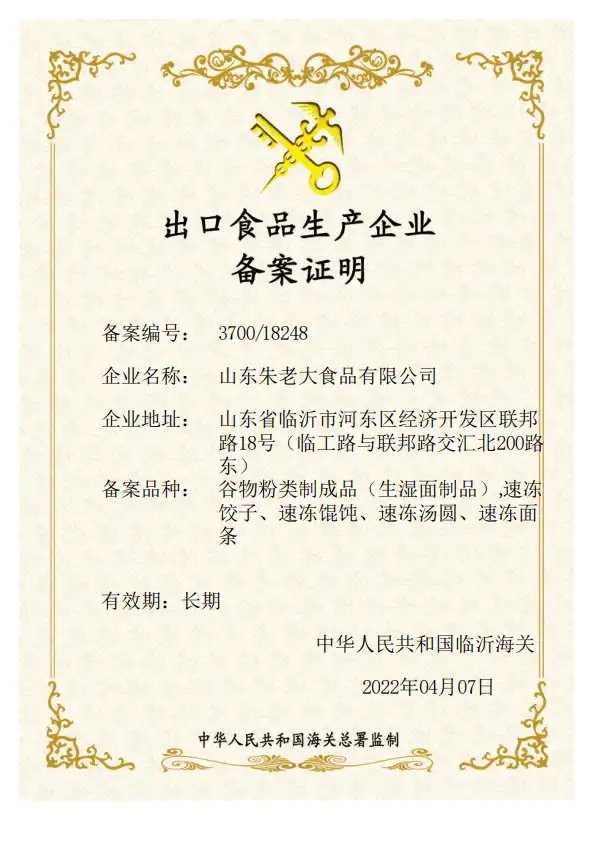
Any supplier worth considering should hold HACCP, ISO 9001, and a valid Food Production License. Zhulaoda carries Food Production License Number SC11137139600148 and is certified under ISO 9001 and HACCP, covering products with egg and chive filling. These credentials are not decorative—they represent documented food safety management systems that auditors can verify. Ask for current certificates with expiry dates, not scanned copies from previous years.
Production Capacity and Supply Stability
Seasonal stockouts are a regular source of frustration for importers. Make sure the manufacturer runs on a scale that can support your volume during busy times. With three automated manufacturing lines that can produce up to 100 tons per day and a cold storage warehouse that can carry more than 8,000 tons, Zhulaoda's capacity profile allows it to handle multi-SKU container orders without interfering with supply. Infrastructure of this kind indicates that the provider can handle surges in demand without interfering with your reorder cycle.
OEM and Packaging Flexibility
To stand out at retail, importers often need private-label choices. Determine whether the provider provides OEM and ODM services. Zhulaoda offers both, offering packaging solutions in 450g, 1kg, and 2.5kg dimensions that may be tailored to meet the needs of your food-service or retail channel. When combining many SKUs into a single container to save cold-chain expenses per unit, this flexibility is crucial.
Procurement Process Best Practices for Importing Eggs and Chives Dumplings
A structured buying process reduces risk at every stage, from initial inquiry to container dispatch.
Sample Evaluation Before Commitment
The sample stage should never be skipped. Ask for a minimum sample size, preferably two to three kilograms, and compare it to your internal sensory scorecard. Verify the durability of the packaging, label correctness, allergy disclosure, and cooking performance. Before committing to a full container, customers may evaluate market reaction with Zhulaoda's trial orders, which have a minimum order amount of around 500 kg. This low entry point lowers first-order financial risk and is intentional.
Contract Clauses That Protect Quality
Batch testing requirements, acceptable defect rate criteria (usually less than 2% for frozen dumplings), and explicit return and refund policies for non-conforming shipments should all be included in your purchase contract. Make it clear that each manufacturing batch requires a Certificate of Analysis (COA) from the supplier. In order to guaranty sufficient retail shelf life during a two to three month maritime freight journey, include shelf-life requirements—a minimum of ten months left upon arrival at the destination port.
Import Compliance and Customs Preparation
U.S. importers must register foreign food facilities with the FDA and ensure prior notice submission before each shipment. Products with egg and chive filling face specific import requirements under USDA/FSIS oversight for egg product compliance. Prepare a complete documentation package: COA, Health Certificate, packing list, and commercial invoice with accurate HS code classification. Delays at customs are most often caused by incomplete paperwork rather than product defects, so build a documentation checklist into your standard operating procedure.
Case Studies: Real-World Applications of Quality Evaluation
Two recurring scenarios from the B2B frozen dumpling market illustrate why a structured quality framework pays off in practice.
Distributor Batch Control Success
Every order was subjected to third-party pre-shipment inspections by a vegetarian food distributor that sources egg and chive dumplings for a local chain of supermarkets in the United States. Over the course of two import cycles, the distributor significantly decreased customer complaints by mandating microbiological test reports, cooking loss rate statistics, and cold-chain records. Stronger shelf performance and less returns were directly correlated with the verification investment.
OEM Partnership for Private Label
A European natural food retailer partnered with Zhulaoda to develop a private-label vegetarian dumpling SKU in 450g packaging. The collaboration required precise label localization—correct allergen declarations for wheat and soy, clear lacto-ovo vegetarian designation, and EU-compliant ingredient listing. The project moved from signed specification sheet to first container dispatch in under ten weeks, supported by Zhulaoda's in-house design team and flexible production scheduling.
Conclusion
Three things are necessary to successfully import eggs and chives dumplings: making sure the quality of the ingredients is checked, making sure the certifications are checked, and using an organized sampling method. Buyers who take the time to evaluate products before they are shipped—checking for allergens, sensory performance, microbiological test results, and the integrity of the cold chain—always do better than buyers who only look at price. In Western markets, the category of frozen vegetarian dumplings is growing. The quality of the product is what turns a trial order into a long-term supply relationship.
FAQ
What is the standard shelf life for frozen chive and egg dumplings?
The shelf life is 12 months when stored continuously at or below -18°C. For import planning, ensure a minimum of 10 months remain upon arrival at your destination port to preserve adequate retail shelf life after sea freight transit.
Are eggs and chives dumplings suitable for vegetarian consumers?
Yes, but they are lacto-ovo vegetarian, not vegan. Labels must clearly declare egg content. Marketing these products as "vegan" without disclosure is a regulatory violation in most Western markets and can trigger product recalls.
What allergens does this product contain?
The ingredients include wheat (from flour) and soy (from Acid-hydrolyzed Vegetable Protein Seasoning Powder), in addition to eggs. All three must appear in the allergen declaration on final packaging.
How do I verify a supplier's food safety certifications?
Request original certificates with issue and expiry dates. Cross-reference the Food Production License number—such as SC11137139600148 for Zhulaoda—against China's national food safety database. For HACCP and ISO 9001, request the issuing body's name and contact details for independent verification.
What cooking methods work for frozen vegetarian dumplings?
Boiling, steaming, and pan-frying are all suitable. For boiling: bring water to a boil, add dumplings, and simmer for 6–8 minutes until they float. This is the most common method for retail consumers.
Source Your Eggs and Chives Dumplings Supplier With Confidence — Contact Zhulaoda
Since 2001, Zhulaoda has been making frozen vegetarian dumplings. They have three automated production lines that can make 100 tons of dumplings every day, and they are certified to follow HACCP and ISO 9001 standards. As a reliable company that makes eggs and chives dumplings, we offer private-label packing in 450g, 1kg, and 2.5kg sizes, container consolidation for multiple SKUs, and low-risk sample orders. You can get samples and a full set of certification documents by emailing sdzldsp@163.com.
References
1. Food and Agriculture Organization of the United Nations. Codex Alimentarius: General Standard for the Labelling of Prepackaged Foods (CODEX STAN 1-1985, Revised 2018). FAO/WHO, 2018.
2. U.S. Food and Drug Administration. Food Facility Registration and Prior Notice for Imported Food. FDA, 2023.
3. International Organization for Standardization. ISO 22000: Food Safety Management Systems — Requirements for Any Organization in the Food Chain. ISO, 2018.
4. U.S. Department of Agriculture, Food Safety and Inspection Service. Egg Products and the Egg Products Inspection Act. USDA/FSIS, 2021.
5. China National Food Safety Standard. SB/T 10412: Quick-Frozen Dumplings (Speed). Ministry of Commerce of the People's Republic of China, 2007.
6. Codex Alimentarius Commission. Code of Hygienic Practice for Refrigerated Packaged Foods with Extended Shelf Life (CAC/RCP 46-1999). FAO/WHO, 1999.

Learn about our latest products and discounts through SMS or email