- English
- French
- German
- Portuguese
- Spanish
- Russian
- Japanese
- Korean
- Arabic
- Greek
- German
- Turkish
- Italian
- Danish
- Romanian
- Indonesian
- Czech
- Afrikaans
- Swedish
- Polish
- Basque
- Catalan
- Esperanto
- Hindi
- Lao
- Albanian
- Amharic
- Armenian
- Azerbaijani
- Belarusian
- Bengali
- Bosnian
- Bulgarian
- Cebuano
- Chichewa
- Corsican
- Croatian
- Dutch
- Estonian
- Filipino
- Finnish
- Frisian
- Galician
- Georgian
- Gujarati
- Haitian
- Hausa
- Hawaiian
- Hebrew
- Hmong
- Hungarian
- Icelandic
- Igbo
- Javanese
- Kannada
- Kazakh
- Khmer
- Kurdish
- Kyrgyz
- Latin
- Latvian
- Lithuanian
- Luxembou..
- Macedonian
- Malagasy
- Malay
- Malayalam
- Maltese
- Maori
- Marathi
- Mongolian
- Burmese
- Nepali
- Norwegian
- Pashto
- Persian
- Punjabi
- Serbian
- Sesotho
- Sinhala
- Slovak
- Slovenian
- Somali
- Samoan
- Scots Gaelic
- Shona
- Sindhi
- Sundanese
- Swahili
- Tajik
- Tamil
- Telugu
- Thai
- Ukrainian
- Urdu
- Uzbek
- Vietnamese
- Welsh
- Xhosa
- Yiddish
- Yoruba
- Zulu
Top Beef and Celery Dumplings for Foodservice Buyers: A Guide
If you're a foodservice buyer or distributor looking to expand your frozen Asian cuisine lineup, beef and celery dumplings deserve serious attention. This guide walks through everything that matters — from nutritional value and sourcing strategy to supplier evaluation and menu positioning. Whether you're stocking retail freezer shelves or supplying Asian restaurant chains across the U.S., understanding what separates a high-performing frozen dumpling from a mediocre one can directly impact your margins and customer retention.
Understanding Beef and Celery Dumplings: Quality and Nutritional Insights
Cultural Roots and Why They Matter for Menu Authenticity
Beef and celery dumplings can be traced back to Shandong province in northern China, where wheat-based wrappers and hearty meat fillings have been a staple comfort food for hundreds of years. This cultural background has real business value for food service buyers who want to attract health-conscious Americans. Not only do menus that list ingredients work better with adventurous customers and international food fans, but menus that tell a story about the area also work better.
Nutritional Profile: The Low-Fat, High-Protein Advantage
By weight, celery is about 95% water, so it doesn't add many calories but does provide fiber, vitamin K, and potassium. When mixed with lean beef hind leg meat, the filling is higher in protein and lower in fat than standard pork-based dumplings. This combination fits perfectly with the "better-for-you" positioning that U.S. consumers and restaurant chains that focus on health are actively looking for.
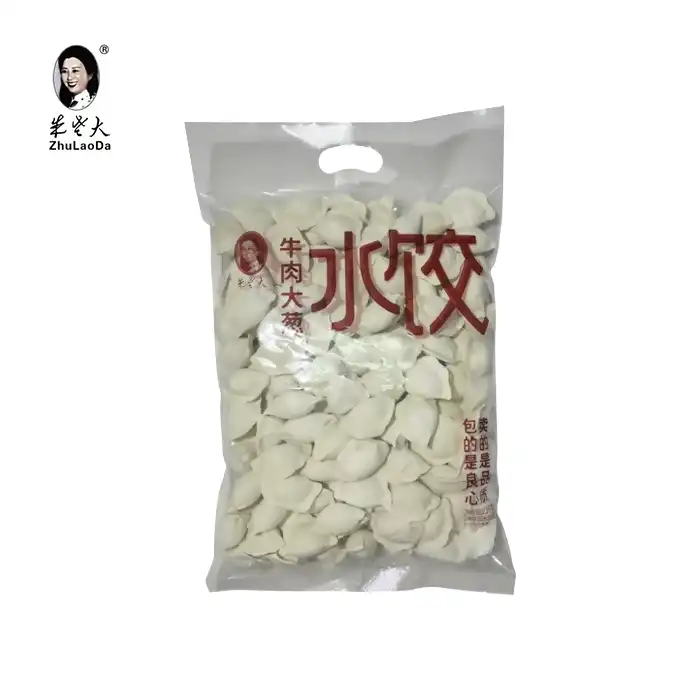
You can get beef and celery dumplings at Zhulaoda. They are made with Beef Hind Leg Meat, which is naturally leaner, fresh celery, scallions, and ginger. This makes a filling that is good for you on the nutrition label without giving up the flavor that keeps people coming back.
Cooking Methods and Frozen Storage Best Practices
In professional kitchens, the best ways to cook are to boil for 6 to 8 minutes, steam for 10 to 12 minutes, or fry until golden. Each method makes a different pattern. The middle stays most moist when steamed, but the bottom gets crispy when pan-fried, which is great for serving as a starter.
It's a must to store frozen foods properly. Keep at -18°C or less throughout the whole cold chain. Changes in temperature above -10°C speed up the formation of ice crystals, which damages the structure of celery cells and makes the wrapping less stable. If you keep Zhulaoda's goods frozen, they will last for 12 months. They have an 8,000-ton cold storage center with an intelligent shuttle rack system to back this up.

Comparing Beef and Celery Dumpling Options for Foodservice Needs
Beef vs. Pork vs. Chicken: Matching Product to Consumer Segment
Even though pork dumplings are still the most popular item in this group, they can be hard to get to some people because of religion or food restrictions. Chicken dumplings tend to have milder flavors and are often bought by people who want to save money. Beef and celery dumplings are in a unique category because they have a stronger flavor, better nutrition, and a wider range of religious tolerance when they come from production lines that only make them without pork.
A beef-based SKU makes it easier for buyers who serve a variety of communities in U.S. metro markets to follow the rules for the halal channel.
Homemade vs. Frozen: The Operational Reality
When restaurant chefs make dumplings by hand, the quality varies and labor costs rise. Buying frozen dumplings from approved makers like Zhulaoda guaranties uniform wrapper thickness (0.8–1.2mm), controlled fat-to-lean ratios, and standard cook times, all of which are important for fast food and catering venues that serve a lot of people.
Here are the main things that make commercially produced frozen dumplings different from those made from scratch:
- Wrapper consistency: Uniform thickness prevents burst wrappers during high-pressure steaming or boiling, which is a common failure point in hand-wrapped products.
- Filling moisture control: Pre-processing osmotic drainage of the celery prevents syneresis (filling water leakage) that softens the wrapper and compromises texture.
- Portion accuracy: Standardized 450g, 1kg, and 2.5kg pack sizes allow precise cost-per-serving calculations across menu engineering workflows.
Together, these qualities help food service operators deal with the problems of maintaining quality and running their businesses more efficiently when they want to expand their Asian dumpling programs beyond a single kitchen.
Sourcing and Procuring Beef and Celery Dumplings Efficiently
What to Look for in a Wholesale Supplier
Buyers from other countries usually buy frozen dumplings including beef and celery in a cycle that lasts between 6 and 12 weeks. This cycle includes an inquiry and sample request, verification by a third-party lab, a small trial order, and then scaling up based on data from past sales. Zhulaoda has three automatic production lines that can make up to 100 tons of goods every day. These lines can handle both small orders and big containers.
- Food safety certifications: ISO9001, HACCP, and National QS certification are baseline requirements. Zhulaoda holds all three, with a Food Production License Number of SC11137139600148.
- Allergen documentation: The product contains wheat and soy components. Verified allergen labeling aligned with FDA FALCPA requirements is essential for U.S. retail and foodservice distribution.
- Traceability: Zhulaoda sources beef from JINLUO — one of China's most recognized chilled fresh meat suppliers — and uses Canadian-imported wheat flour alongside flour from China's Hetao Plain. This level of raw material transparency supports origin traceability audits.
- OEM/ODM capability: Packaging customization in 450g, 1kg, and 2.5kg formats, with English-language nutrition labels and allergen callouts, reduces barriers for U.S. import declaration.

The standard procurement cycle for international frozen dumpling buyers runs 6–12 weeks: inquiry and sample request, third-party lab verification, small trial order, then scale-up based on sell-through data. Zhulaoda's three automated production lines, with a daily output ceiling of 100 tons, support both trial quantities and full container orders.
Enhancing Menu Appeal with Beef and Celery Dumplings
Cooking Techniques and Dipping Sauce Pairings
Dumplings that have been fried in a pan and served with a light chili-sesame sauce are great as small plates or starters. When steamed, they go well with either a ginger-scallion oil dip or a simple black vinegar dip. Both forms look healthy. It doesn't cost much to add these sides, but they make the meal seem much more valuable.
Positioning Strategy: Bridging Traditional and Contemporary Diners
When presented correctly, the combination of beef and celery has a "clean eating" story that non-Chinese consumers can relate to. Using words like "lean beef," "crisp celery," and "northern Chinese tradition" in the menu copy connects real food with the health-related language that U.S. consumers use to decide what to buy. This positioning can be used by stores to make signs for the freezer aisle, and restaurants can use it in digital menu descriptions and social media posts.
Decision Support: Choosing the Right Beef and Celery Dumplings for Your Business
Choosing the right provider for frozen dumplings is a risk management choice at its core. Total landed cost and profit protection are affected by things like product quality, following rules, being able to compete on price with Southeast Asian options, and the dependability of the cold chain.
Zhulaoda has been the biggest frozen food processing base in southern Shandong and northern Jiangsu since it opened in March 2001. This is the result of over 20 years of manufacturing scale and process discipline. Their smart cold storage system and ability to package in multiple formats make them a good long-term partner for distributors who have to deal with changing volume levels in food service and retail channels.
Buyers who care a lot about following the rules should know that this group of products is controlled by the product standard code SB/T 10412, which makes sure that Chinese national standards for making frozen dumplings are met. For help with import declarations, full paperwork is provided.
Conclusion
For U.S. food service buyers and Asian frozen food distributors, beef and celery dumplings present a truly compelling category opportunity. One important thing that can set a distributor's frozen goods apart is how healthy they are, how true to culture they are, and how easy they are to use.
The important thing is to work with a maker whose certifications, ability to be tracked, and OEM freedom meet the U.S. market's requirements for branding and compliance. Zhulaoda meets all of these requirements with its proven supply capacity, full certification coverage, and flexible packing that meets the needs of both store and food service customers who speak English.
FAQ
How long do frozen beef and celery dumplings take to cook in a commercial kitchen?
From frozen, it takes 6–8 minutes to boil. It takes 10–12 minutes to steam. Add a little water and cover the pan. Fry until the bottom is golden brown. This usually takes 8–10 minutes. Before using, you should always make sure that the temperature inside the filling chamber reaches 74°C (165°F).
Are gluten-free versions available?
The shell for Zhulaoda's current beef and celery dumplings is made of wheat flour, and the filling is made of soy-based ingredients. Both have been named allergens. For gluten-free versions, the wrapper would need to be modified, which can be done through talks about OEM product development.
How can buyers verify a supplier's food safety standards before placing an order?
You can directly ask for records of the ISO9001, HACCP, and QS licenses. Check the Food Production License Number (SC11137139600148 for Zhulaoda) against the national food safety database of China. It is common practice and highly suggested that product samples be tested by a third-party lab before orders for whole containers are placed.
Does the product comply with U.S. allergen labeling requirements?
The item has both wheat and soy in it, which are classified as major allergens by the FDA FALCPA. Zhulaoda allows for English-language allergy labeling and packaging customization to meet U.S. import and store compliance standards.
Partner with Zhulaoda — A Certified Beef and Celery Dumplings Manufacturer
Zhulaoda brings to every relationship more than 20 years of experience making frozen foods, ISO9001/HACCP approval, and the ability to store 8,000 tons of food in the cold. We are a reliable supplier of beef and celery dumplings to distributors around the world, and we offer sample packs, OEM packaging, and flexible bulk pricing. You can email our purchasing team at sdzldsp@163.com or go to zhulaodadumpling.com to get more information and to start your trial order right away.
References
1. Food and Agriculture Organization of the United Nations. Meat Processing Technology for Small- to Medium-Scale Producers. FAO, 2007.
2. International Food Information Council. Consumer Attitudes Toward Food Safety, Nutrition & Health. IFIC Foundation, 2023.
3. U.S. Food and Drug Administration. Food Allergen Labeling and Consumer Protection Act (FALCPA): Guidance for Industry. FDA, 2006.
4. Codex Alimentarius Commission. General Standard for Quick Frozen Foods for Direct Human Consumption (CODEX STAN 8-1976, Rev. 2008). WHO/FAO, 2008.
5. Journal of Food Science. Effect of Freezing Rate on Quality Attributes of Stuffed Pasta Products. Institute of Food Technologists, 2019.
6. Mintel Group Ltd. Asian Foods — U.S. Market Report: Frozen Category Trends and Consumer Demand. Mintel, 2022.

Learn about our latest products and discounts through SMS or email